From Petri Dish to Harvest: The Journey Behind Every Bottle of Mycorise Lion's Mane
- Dante Garth
- Jun 26
- 12 min read

Updated: Jul 7

More Than Just a Supplement
When most people pick up a bottle of Lion's Mane extract, they see a finished product.
What they don't see are the weeks of preparation, patience, and care that went into creating it.
They don't see the late nights spent checking temperatures, monitoring humidity, or carefully observing each stage of growth. They don't experience the anticipation of waiting for the first tiny pins to appear or the satisfaction of harvesting a beautiful, healthy mushroom.
At Mycorise, every bottle begins as a tiny culture inside a petri dish and slowly transforms through a process that simply cannot be rushed.
From sterilizing equipment and preparing substrates to harvesting, drying, and extracting, every step is completed by hand and guided by one simple belief:
Nature works on its own timeline, and great products are worth the wait.
This is the journey behind every bottle of Mycorise Lion's Mane extract.
__________________________________________________________________________________
Step 1: It All Begins With Healthy Genetics

Every bottle of Mycorise Lion's Mane begins with a tiny sample of living mycelium placed onto a nutrient-rich agar plate.
This stage allows us to:
✔️ Verify healthy, vigorous growth
✔️ Observe the culture closely over time
✔️ Select strong, desirable genetics
✔️ Detect contamination before it can spread to future stages of production
A healthy culture is the foundation of everything that follows. Taking the time to carefully evaluate each plate helps ensure that only the strongest and cleanest cultures move forward in the growing process.
Why this matters: The quality of the final extract starts here. Strong genetics and clean cultures lead to healthier mushrooms, better consistency, and ultimately a higher-quality Lion's Mane extract.
Typical time required: 1–2 weeks.
__________________________________________________________________________________
Step 2: Preparing the Grain


Rye berries become the first food source for the mycelium and provide the nutrients needed for rapid colonization.
Each batch of grain is carefully cleaned, hydrated, and prepared to achieve the proper moisture content.
Too much moisture can invite contamination.
Too little moisture can slow growth and reduce colonization.
This stage requires consistency, precision, and attention to detail, as even small variations can affect everything that follows.
Why this matters: Properly prepared grain provides the ideal environment for the mycelium to establish itself and multiply. Strong grain colonization lays the foundation for healthy substrate colonization and successful mushroom production.
Typical time required: 12–24 hours of preparation, followed by sterilization and cooling before inoculation.
__________________________________________________________________________________
Step 3: Sterilization


Before the mycelium can be introduced, both the grain and substrate must be thoroughly sterilized.
Using a pressure cooker at approximately 15 PSI, temperatures become high enough to destroy bacteria, molds, and competing fungi that could overtake the culture.
This process creates a clean environment where Lion's Mane mycelium can establish itself and grow without competition.
Even though the bags may look simple from the outside, this is one of the most important stages in the entire process. Success or failure often depends on how well sterilization is performed.
Why this matters: Even a tiny amount of contamination can ruin weeks of work. Proper sterilization gives Lion's Mane the best possible chance to thrive.
Typical time required: Approximately 90 minutes under pressure, followed by several hours of cooling before inoculation can begin.
__________________________________________________________________________________
Step 4: Inoculation and Colonization


Once the sterilized grain has completely cooled, it is introduced to a healthy Lion's Mane culture.
From this point forward, nature takes over.
Over the following weeks, the mycelium slowly spreads from grain to grain, forming a dense white network of life. What begins as a small piece of culture gradually transforms into a fully colonized jar, rich with energy and ready for the next stage of growth.
This stage teaches one of the most important lessons in mushroom cultivation:
Patience.
There are no shortcuts.
No way to force faster growth.
The mycelium moves at its own pace, and our job is simply to provide the proper environment and let nature do what it does best.
Why this matters: Strong, healthy grain spawn creates the foundation for everything that follows.
Fully colonized grain provides the nutrients and vigor needed to successfully colonize the substrate and ultimately produce healthy Lion's Mane mushrooms.
Typical time required: Approximately 2–4 weeks, depending on environmental conditions and the vigor of the culture.
__________________________________________________________________________________
Step 5: Preparing the Fruiting Substrate
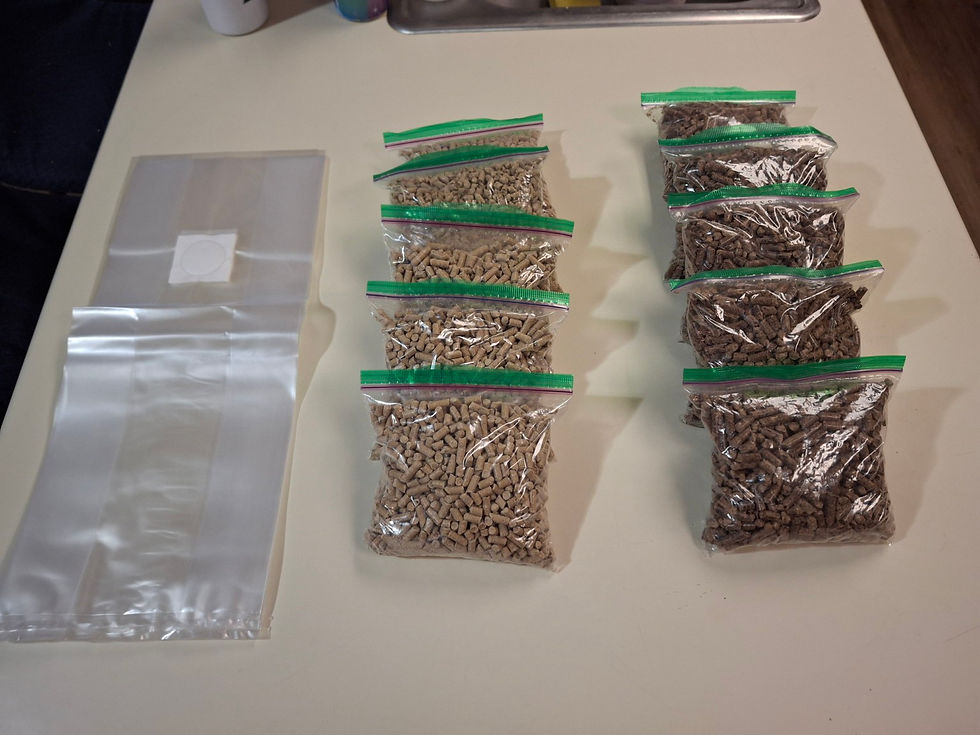


Once the grain has become fully colonized, it is ready for its next home.
The colonized grain is carefully transferred into larger grow bags containing:
🌾 Organic soy hulls
🌳 Hardwood pellets
💧 Carefully measured water
Together, these simple ingredients create a nutrient-rich environment that provides the mycelium with everything it needs to continue growing and eventually produce Lion's Mane mushrooms.
After the bags are mixed, the mycelium begins its journey once again—slowly spreading throughout the fresh substrate and transforming it into a dense, living network.
This stage is another lesson in patience.
What appears to be a simple bag of sawdust and grain is actually becoming the foundation for future harvests.
Why this matters: The quality of the substrate directly influences the health, vigor, and productivity of the mushrooms. Strong ingredients and proper preparation create the conditions needed for healthy growth and successful harvests.
Typical time required: Approximately 2–4 weeks for full colonization, depending on environmental conditions and the vigor of the culture.
__________________________________________________________________________________
Step 6: Sterilization – Eliminating Unwanted Competitors


In mushroom cultivation, success often comes down to one simple principle:
Give the mushroom a clean environment to thrive.
Healthy Lion's Mane mycelium is constantly competing against unwanted organisms such as molds, bacteria, and wild fungi. If these contaminants are allowed to survive, they can quickly overtake a grow bag and bring weeks of hard work to an end.
To prevent this, every jar and grow bag is sterilized under high heat and pressure inside a pressure cooker.
At approximately 15 PSI, temperatures become high enough to destroy microorganisms that could compete with the Lion's Mane culture, creating a clean foundation for healthy growth.
Sterilization is one of the most important stages in the entire process.
Even perfectly prepared grain and substrate can fail if this step is rushed or performed improperly.
Because in mushroom cultivation, small details often determine success.
Why this matters: Sterilization dramatically reduces the presence of competing organisms and gives the Lion's Mane mycelium the best possible opportunity to establish itself and thrive.
Typical time required: Approximately 90 minutes under pressure, followed by several hours of cooling before inoculation can begin.
__________________________________________________________________________________
Step 7: Inoculation – Introducing the Living Culture


Once everything has completely cooled, the sterilized grain and substrate are inoculated with healthy Lion's Mane mycelium.
This step takes place inside a Still Air Box (SAB)—a simple but highly effective sterile workspace designed to minimize airborne contaminants and protect the culture during transfer.
Using sterile techniques, a small piece of colonized agar or grain spawn is carefully introduced into each jar and grow bag.
Although the amount of mycelium added may seem incredibly small, it contains everything needed to eventually colonize pounds of substrate and produce beautiful Lion's Mane mushrooms.
This moment marks the true beginning of the cultivation process.
From here, the mycelium begins to spread, slowly transforming its new environment into a living network of white growth.
The journey from a tiny culture to a finished bottle of extract starts with this single transfer.
Why this matters: Proper inoculation gives the mycelium a clean, healthy start and greatly reduces the risk of contamination. The strength and health of the culture introduced at this stage can influence every step that follows.
Typical time required: A few hours to complete the inoculation process, followed by several weeks of patient observation and growth.
__________________________________________________________________________________
Step 8: Colonization – Building the Foundation

After inoculation, the jars and grow bags are placed into incubation and left undisturbed.
Over the following weeks, the mycelium slowly spreads throughout the grain and substrate, digesting nutrients and creating a vast underground network of white threads.
This stage teaches patience.
There is no shortcut.
No way to force faster growth.
Each day, the mycelium expands a little further until eventually the entire bag becomes one living organism.
Watching a small patch of white growth slowly transform and consume an entire block of substrate never gets old. It's a reminder that some of nature's most incredible processes happen quietly, one day at a time.
This is where the foundation for a healthy harvest is built.
Why this matters: Full colonization allows the mycelium to establish itself, store energy, and prepare for fruiting. Strong, healthy colonization greatly improves the chances of producing vigorous, productive mushrooms.
Typical time required: Approximately 2–4 weeks, depending on environmental conditions and the vigor of the culture.
__________________________________________________________________________________
Step 9: Full Colonization – A Living Block of Mycelium

Eventually, the mycelium reaches every corner of the substrate.
What once looked like a simple bag of hardwood and soy hulls has now transformed into a dense, fully colonized block of living mycelium.
At this point, weeks of patience, observation, and careful preparation have finally paid off.
This stage is incredibly rewarding because it signals that the mycelium has successfully established itself and is ready for the next phase of its journey.
A fully colonized block is essentially a giant energy reserve, storing everything needed to begin producing mushrooms.
Although the outside may appear quiet and unchanged, the block is alive with activity and preparing for one of nature's most fascinating transformations.
The next step is creating the perfect environment for the first Lion's Mane mushrooms to emerge.
Why this matters: Full colonization allows the mycelium to build strength, store nutrients, and prepare for fruiting. A healthy, fully colonized block greatly improves the chances of producing vigorous, productive mushrooms.
Typical time required: Approximately 3–5 weeks from inoculation, depending on genetics and environmental conditions.
__________________________________________________________________________________
Step 10: Grow Tent Cleaning and Environmental Maintenance


As mushrooms begin developing, maintaining a clean growing environment becomes just as important as the earlier sterile stages.
Throughout the fruiting process, our grow tents are regularly inspected and cleaned to remove debris, old mushroom tissue, and any potential contaminants. Equipment, shelves, and surfaces are sanitized to help create an environment where healthy Lion's Mane can thrive.
At the same time, environmental conditions are carefully monitored and adjusted, including:
💧 Humidity
🌡️ Temperature
🌬️ Fresh air exchange
🫧 Carbon dioxide levels
Mushrooms are living organisms that are highly sensitive to their surroundings. Even small changes in the environment can influence growth and development.
Proper sanitation and environmental management help reduce contamination risks and provide the conditions needed for each harvest to reach its full potential.
This commitment to cleanliness and consistency is one of the many reasons we take our time with every batch.
Because producing high-quality mushrooms isn't just about growing them—
It's about creating and maintaining an environment where they can truly thrive.
Why this matters: A clean, carefully managed fruiting chamber helps protect developing mushrooms, reduce contamination risks, and create the conditions needed for healthy, productive harvests.
Typical time required: Daily monitoring and maintenance throughout the entire fruiting cycle.
__________________________________________________________________________________
Step 11: Introducing the Blocks to the Fruiting Chamber

Growing Lion's Mane isn't as simple as placing a block in a humid room and waiting.
Before a single colonized block enters the fruiting chamber, we carefully prepare the environment that will support the next stage of its journey.
Every fruiting chamber is dialed in to maintain:
💧 Humidity – Maintained at high levels to support healthy mushroom development.
🌡️ Temperature – Carefully monitored to create conditions that encourage fruiting.
🌬️ Fresh Air & Carbon Dioxide Levels – Balanced to help the mushrooms develop their signature fluffy, cascading appearance.
🫧 Sanitation – The chamber is cleaned and prepared to reduce the risk of contamination.
Every species of mushroom has its own preferences, and Lion's Mane is no exception.
Creating the proper environment is one of the most important steps in the entire cultivation process because even small changes in temperature, humidity, or airflow can influence how the mushrooms grow.
Only when everything is stable and ready do we introduce the fully colonized blocks into their new environment.
This moment marks the transition from weeks of preparation to the exciting stage of mushroom formation.
Because at Mycorise, we believe preparation matters just as much as the harvest.
Why this matters: Creating a stable and carefully managed fruiting environment gives Lion's Mane the best opportunity to produce healthy, vigorous mushrooms and helps ensure consistent results from batch to batch.
Typical time required: Environmental conditions are monitored and adjusted daily throughout the entire fruiting cycle.
__________________________________________________________________________________

After weeks of preparation, sterilization, colonization, and environmental control, the moment we've been waiting for finally arrives.
Tiny white formations called pins begin to emerge from the blocks. These small growths are the very first stage of what will eventually become full Lion's Mane mushrooms.
At this stage, patience is everything.
The fruiting chamber is carefully monitored to maintain:
💧 High humidity levels
🌬️ Proper fresh air exchange
🌡️ Stable temperatures
🫧 A clean growing environment
Every day, the mushrooms respond to these conditions, slowly transforming from tiny pins into the beautiful cascading fruits that Lion's Mane is known for.
This stage is always exciting because it serves as proof that all of the previous work—from preparing substrate and sterilization to inoculation and colonization—has been successful.
From this point forward, nature takes over, and we simply provide the environment for these incredible mushrooms to do what they've evolved to do.
This is where Mycorise truly begins to come to life.
Why this matters: Pinning is the first visible sign that the mycelium is healthy, energized, and ready to begin producing mushrooms. It marks the transition from a living block of mycelium to the beginning of a harvest.
Typical time required: Tiny pins often begin appearing within several days of introducing the blocks to fruiting conditions, with mature mushrooms developing over the following days and weeks.
__________________________________________________________________________________
Step 13: The Harvest

This stage is where patience pays off.
The mushroom has transformed from tiny pins into a dense, snow-white fruiting body covered in thousands of delicate spines. Every mushroom is harvested by hand at the peak of freshness to preserve its quality and beneficial compounds.
At Mycorise, we don't rush this process.
We monitor:
✓ Size and development
✓ Color and overall health
✓ Texture and density
✓ Timing of harvest
Harvesting too early can reduce yield, while harvesting too late can impact quality. Finding that perfect window is both a science and an art.
Each harvest represents weeks of work:
🌱 Preparing the substrate
🔥 Sterilizing and inoculating
🌡️ Controlling the environment
💧 Maintaining humidity and fresh air
⏳ Waiting patiently for nature to do its work
This beautiful Lion's Mane is more than a mushroom—it's the result of dedication, patience, and respect for the growing process.
And this is only the beginning.
The next step is carefully drying the harvest to preserve it before moving into the extraction process that transforms these mushrooms into our dual-extract tincture.
__________________________________________________________________________________

A Reward for Patience
Not every harvest looks the same. Some fruits remain smaller and more compact, while others develop into truly impressive specimens.
This particular harvest weighed in at 3 pounds and 0.6 ounces of fresh Lion's Mane mushroom.
Large, healthy fruits like this are the result of many factors working together:
✓ Proper substrate preparation
✓ Thorough sterilization
✓ Strong, healthy genetics
✓ Consistent humidity and fresh air exchange
✓ Careful environmental monitoring
✓ Most importantly—patience
Seeing a mushroom reach this size is a reminder that growing Lion's Mane is a process that simply can't be rushed. Every stage builds upon the one before it, and when the conditions are right, the results can be extraordinary.
At Mycorise, each harvest is hand-inspected and carefully prepared before moving on to the next stages of its journey.
This is why our process takes weeks, not hours.
Because great things rarely happen overnight.
Every bottle we create begins with a tiny culture, countless small decisions, and weeks of dedication.
From the first signs of mycelium to a harvest like this one, our mission has always been the same:
To create something we would be proud to share with our own families.
Nature works on its own timeline—and we believe great products are worth the wait.
__________________________________________________________________________________
Follow the Journey
This harvest may mark the end of the growing process, but it's only the beginning of the story.
Next, these mushrooms will be carefully dried, extracted, and transformed into our handcrafted dual-extract tincture.
🍄 Explore Our Lion's Mane Tincture
__________________________________________________________________________________
FDA Disclaimer
These statements have not been evaluated by the Food and Drug Administration. Mycorise products are not intended to diagnose, treat, cure, or prevent any disease.


Comments