From Second Flush to Finished Tincture: What Happens After a Lion’s Mane Harvest
- Dante Garth
- Jul 21
- 6 min read


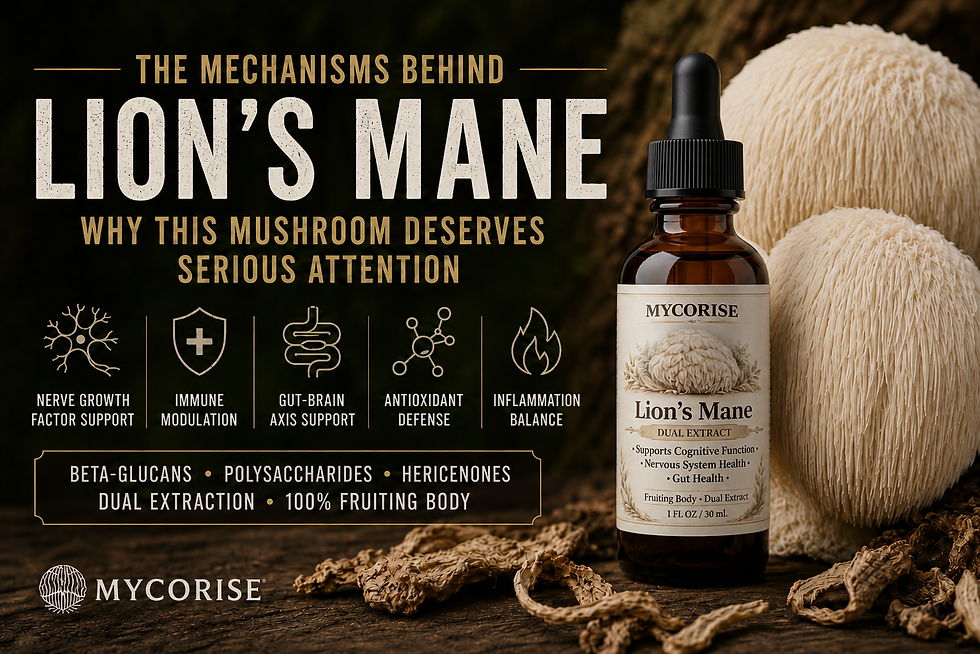
A finished bottle of Lion’s Mane tincture may look simple.
Amber glass.
A dropper.
A label.
A measured serving.
But the finished bottle is only the final stage of a much longer process.
Before Lion’s Mane can be dried, extracted, filtered, bottled, packaged, and delivered, it first has to grow.
That means preparing substrate.
Sterilizing materials.
Inoculating cultivation blocks.
Waiting for colonization.
Managing humidity, temperature, airflow, and carbon dioxide.
Watching the mushrooms develop.
Harvesting them at the right time.
And sometimes, after the first harvest is complete, giving the block enough time and care to produce again.
Today, Mycorise harvested **1,550 grams of fresh Lion’s Mane from a second flush**.
That harvest will now move through several additional stages before it can become part of a finished tincture.
This is what happens after the mushroom leaves the grow block.
1. What Is a Second Flush?

A cultivation block does not always stop producing after the first harvest.
When conditions remain favorable, the mycelium inside the block may produce another round of mushrooms.
That next round is called a **second flush**.
The first flush is often the largest or most visually impressive, but a productive second flush can still add a meaningful amount of usable Lion’s Mane.
That matters to a small producer.
Every additional harvest helps make better use of the ingredients, time, energy, and equipment that went into preparing the cultivation block.
It also provides more information.
Each flush teaches me how the strain responds to changes in airflow, humidity, temperature, harvest timing, and recovery time.
Cultivation is not simply about following a recipe.
It is an ongoing process of observation.
The mushrooms respond to their environment, and the grower has to learn how to read those responses.
2. Harvest Timing Matters

Lion’s Mane changes quickly as it matures.
Young fruits may begin as dense, rounded masses with very short teeth.
As they develop, the spines become more visible and begin to lengthen.
The grower has to balance several factors.
Harvesting too early may reduce the final size.
Waiting too long may allow the mushroom to discolor, dry around the edges, soften, or move beyond its best condition.
The ideal harvest window is not determined by size alone.
Color matters.
Texture matters.
Spine development matters.
The condition of the growing surface matters.
And the overall appearance of the fruiting body matters.
This is one reason small-batch cultivation requires frequent observation.
The mushrooms do not follow a clock with perfect precision.
They have to be watched.
3. The Harvest Is Cleaned and Weighed

After harvesting, the mushrooms are inspected and cleaned.
Any remaining substrate material is removed.
Damaged sections are separated when necessary.
The fruiting bodies are then weighed.
The weight is not only something to share online.
It is part of the production record.
Tracking harvest weight helps answer important cultivation questions.
How productive was the block?
How did the second flush compare with the first?
Did the environmental conditions improve or reduce performance?
Was the harvest taken at the correct time?
How much fresh material is moving into dehydration?
Small-batch production still requires data.
The records may begin in a notebook or spreadsheet rather than an industrial database, but the purpose is the same.
Document what happened.
Learn from it.
Improve the next cycle.
4. Fresh Weight Is Only the Beginning

A fresh mushroom is mostly water.
That means 1,550 grams of freshly harvested Lion’s Mane will not remain 1,550 grams after drying.
As moisture leaves the mushroom, the weight decreases significantly.
This is normal.
The goal of dehydration is not to preserve the original weight.
The goal is to remove moisture thoroughly enough to create a stable dried ingredient for the next stage of production.
Fresh weight shows cultivation yield.
Dry weight shows how much preserved mushroom material is available for storage and extraction.
Both numbers matter, but they represent different parts of the process.
This is why a large fresh harvest does not translate directly into the same amount of finished tincture.
The mushroom still has to be dried, measured, extracted, filtered, combined, and bottled.
5. Preparing Lion’s Mane for Dehydration

Large Lion’s Mane fruiting bodies cannot simply be placed into storage while they are still fresh.
Moisture trapped inside thick pieces can create problems.
To improve drying consistency, larger mushrooms are divided into smaller sections and arranged across dehydrator trays.
Spacing matters.
Air needs room to move around the mushroom.
Pieces that are packed too tightly may dry unevenly.
Very thick sections may require more time than thin sections.
The mushrooms are checked throughout the process rather than assumed to be finished simply because a timer has ended.
Proper dehydration requires patience.
The outside of a piece may feel dry before the center is ready.
That is why the mushroom has to be examined for dryness throughout the entire piece.
6. Why Dehydration Matters

Dehydration is more than a cosmetic step.
It prepares the Lion’s Mane for storage.
It also allows the mushroom to be weighed more consistently before extraction.
Fresh mushrooms can vary considerably in moisture content.
Dried mushroom material provides a more dependable basis for measuring extraction ratios.
That consistency matters when a producer wants future batches to follow the same process.
The goal is not simply to dry the surface.
The goal is to remove enough moisture throughout the mushroom so the material becomes stable, crisp, and ready for the next stage.
Once fully dried, the Lion’s Mane can be stored appropriately until enough material is ready for extraction.
7. The Fruiting Body Becomes the Extraction Material

Mycorise tincture begins with the actual Lion’s Mane fruiting body.
The mushroom is grown.
Harvested.
Cleaned.
Weighed.
Cut.
Dehydrated.
And stored.
Only then is it ready to become extraction material.
This is an important distinction.
The finished liquid does not begin as an anonymous bulk powder purchased without a visible production history.
It begins with mushrooms that were observed from colonization through harvest.
That creates a direct connection between cultivation and the finished product.
The ingredient is not separate from the story of the business.
The ingredient is the story.
8. From Dried Mushroom to Dual Extraction

Drying is not the final step.
Lion’s Mane contains different groups of naturally occurring compounds, and they do not all extract in the same way.
Some are more compatible with hot water.
Others are better captured through alcohol extraction.
That is why Mycorise uses a dual-extraction process.
The alcohol extraction is prepared over an extended period.
The hot-water extraction is completed separately.
The two portions are then filtered, measured, and carefully combined.
This process takes time.
The mushrooms take time to grow.
They take time to recover and produce another flush.
They take time to dehydrate.
And they take time to extract.
The process is not designed around producing the fastest possible bottle.
It is designed around respecting each stage.
9. Why Documenting the Process Matters

Transparency is not only about showing attractive mushrooms.
It also means documenting the less glamorous parts.
Weights.
Dates.
Harvests.
Flushes.
Drying times.
Extraction stages.
Batch measurements.
And observations about what worked and what needs improvement.
Those details create continuity.
They help one batch teach the producer how to improve the next.
They also allow customers to understand that the finished product did not appear from nowhere.
There is a chain behind it.
Cultivation.
Harvest.
Preservation.
Extraction.
Bottling.
Packaging.
Delivery.
Every stage affects the stage that follows.
Final Thoughts
Today’s 1,550-gram second-flush harvest was not the end of a production cycle.
It was the beginning of the next stage.
Those mushrooms still need to be cleaned.
Weighed.
Separated.
Dehydrated.
Stored.
Measured.
Extracted.
Filtered.
Combined.
And eventually bottled.
That is what small-batch production looks like.
It is not one dramatic moment.
It is a series of careful steps completed repeatedly.
At Mycorise, every bottle begins with:
🍄 Real Lion’s Mane fruiting bodies
🌿 Small-batch cultivation
⚖️ Documented harvest weights
♨️ Careful dehydration
🧪 Alcohol and hot-water extraction
📍 Wisconsin-made attention to detail
The finished bottle is important.
But the process behind the bottle is what gives it meaning.
**Grown with purpose. Extracted with integrity.**

A Note on Wellness
Lion’s Mane supplements are not intended to replace a balanced diet, quality sleep, regular exercise, stress management, or professional medical care.
Individual experiences may vary.
Consult your healthcare provider before introducing a new supplement into your routine, especially if you are pregnant, nursing, taking medication, managing a medical condition, or sensitive to mushrooms.
FDA Disclaimer
These statements have not been evaluated by the Food and Drug Administration. Mycorise products are not intended to diagnose, treat, cure, or prevent any disease.


Comments