The Mechanisms Behind Lion’s Mane: Why This Mushroom Deserves Serious Attention
- Dante Garth
- Jul 11
- 8 min read

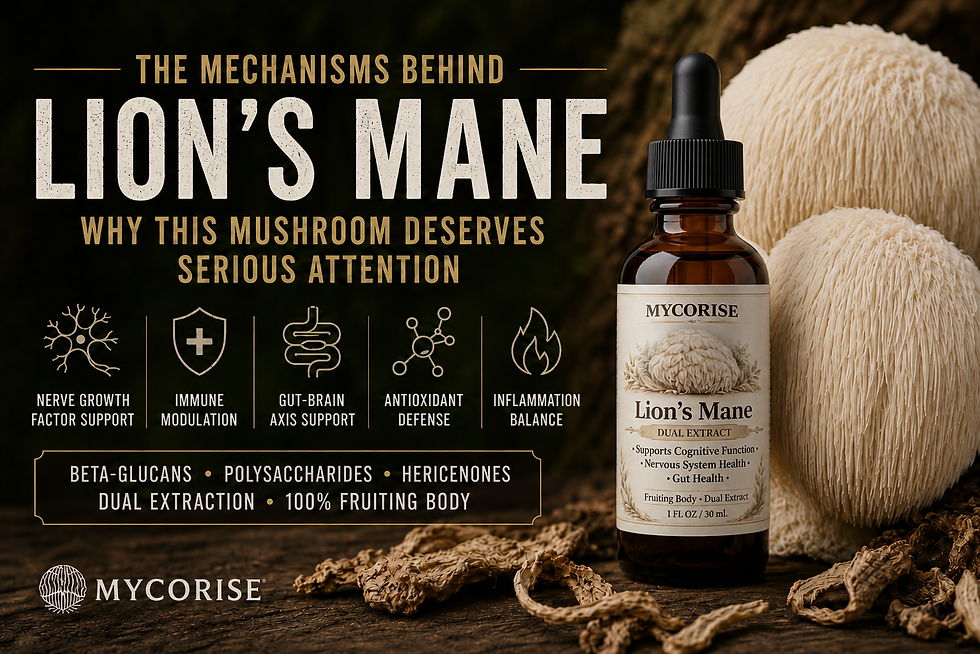
Lion’s Mane mushroom, also known as Hericium Erinaceus, has become one of the most talked-about functional mushrooms in the wellness world.
But I do not believe Lion’s Mane should be taken seriously just because it is popular.
I believe it should be taken seriously because of the mechanisms behind it.
When you look deeper, Lion’s Mane is not just “a mushroom for focus.”
It is a complex organism containing naturally occurring compounds that interact with the body through multiple pathways.
Some compounds are being studied for their relationship to nerve growth factor.
Some are being studied for immune signaling.
Some are being studied for gut health.
Some are being studied for antioxidant and inflammation-related pathways.
That is what makes Lion’s Mane so interesting.
It does not appear to work through one single pathway.
It appears to be a multi-system mushroom.
That does not mean it is a cure.
That does not mean it works overnight.
And it does not mean every person will feel the same thing.
But it does explain why researchers, growers, and wellness-minded people continue to pay attention to it.
At Mycorise, this is the part of Lion’s Mane that fascinates me most.
Not the hype.
The mechanisms.
1. Beta-Glucans and Immune Recognition

One of the most important groups of compounds found in functional mushrooms is beta-glucans.
More specifically, mushroom beta-glucans are often discussed as β-(1→3)/(1→6)-glucans.
These are complex polysaccharides, or long-chain carbohydrates, found in the cell walls of mushrooms.
What makes them interesting is how the body recognizes them.
The immune system has certain receptors designed to detect patterns commonly found in fungi, bacteria, and other organisms. These are called pattern recognition receptors.
One of the most important beta-glucan receptors is called Dectin-1.
Dectin-1 is found on immune cells such as macrophages and dendritic cells.
Macrophages are often described as sentinel cells because they patrol tissues, detect threats, communicate with other immune cells, and help coordinate immune responses.
When beta-glucans interact with receptors like Dectin-1, they can influence immune signaling pathways.
In simple terms:
Beta-glucans may help “wake up” certain immune cells by giving them a recognizable mushroom signal.
That does not mean Lion’s Mane “boosts” the immune system in a reckless way.
A better word is modulates.
Immune modulation means helping the immune system communicate, respond, and regulate itself appropriately.
That distinction matters.
At Mycorise, I do not look at Lion’s Mane as a magic immune booster.
I look at it as a mushroom containing compounds that the immune system is biologically equipped to recognize.
That is powerful.
2. The Macrophage Connection

Macrophages are one of the most fascinating parts of the immune system.
They are like biological security guards.
They patrol.
They inspect.
They clean up debris.
They communicate with other immune cells.
And they help decide what kind of immune response is needed.
Beta-glucans are interesting because they can interact with receptors found on macrophages and other immune cells.
Dectin-1 does two important things:
First, it helps immune cells recognize beta-glucan-containing particles.
Second, it helps transmit signals inside the cell that influence immune communication.
That means mushroom beta-glucans are not just “fiber.”
They are biologically active structures that the immune system can detect.
This is one reason functional mushrooms have been studied for immune wellness.
Again, this is not the same as saying Lion’s Mane treats disease.
It means the mushroom contains compounds that interact with normal immune recognition pathways.
That is one of the key mechanisms that makes Lion’s Mane worth understanding.
3. Polysaccharides and the Gut-Brain Axis

Lion’s Mane is often called a “brain mushroom,” but the story does not stop with the brain.
The gut matters too.
The gut contains trillions of microbes that help influence digestion, immune function, metabolism, and even communication with the nervous system.
This connection is often called the gut-brain axis.
Mushroom polysaccharides are interesting because they may act as prebiotic-like compounds.
That means they may influence the gut environment by interacting with gut bacteria and supporting microbial activity.
When gut bacteria ferment certain fibers and polysaccharides, they can produce compounds called short-chain fatty acids, often shortened to SCFAs.
SCFAs are studied for their relationship to gut barrier function, immune regulation, and communication between the gut and the rest of the body.
This matters because the gut, immune system, and nervous system are constantly communicating.
So when people talk about Lion’s Mane and cognitive wellness, I think it is too narrow to only talk about the brain.
The gut may be part of the story too.
Lion’s Mane appears to be interesting because it may support multiple connected systems at once.
Brain.
Gut.
Immune signaling.
Nervous system.
That is why I look at it as a whole-body mushroom, not just a focus product.
4. Hericenones and Nerve Growth Factor

One of the biggest reasons Lion’s Mane gets attention is because of its relationship to Nerve Growth Factor, often called NGF.
NGF is a protein involved in the growth, maintenance, and survival of certain nerve cells.
In simple terms, NGF helps support the environment nerve cells need to function, communicate, and maintain themselves.
Lion’s Mane contains compounds called hericenones, which are commonly associated with the fruiting body of the mushroom.
The fruiting body is the actual mushroom — the white, shaggy Lion’s Mane that gets harvested.
Researchers have studied hericenones because of their potential relationship to NGF-related activity.
This does not mean Lion’s Mane instantly grows new nerves.
It does not mean it repairs the brain overnight.
It does not mean it cures neurological disease.
But it does mean there is a real biological reason Lion’s Mane is discussed in conversations about cognitive wellness and nervous system support.
At Mycorise, this is one of the reasons I focus on 100% fruiting body Lion’s Mane.
I want the actual mushroom to be the foundation of the product.
5. Erinacines and the Bigger Lion’s Mane Research Story

When discussing Lion’s Mane science, another group of compounds often comes up:
Erinacines.
Erinacines are more commonly associated with Lion’s Mane mycelium.
Mycelium is the root-like network of the fungus that grows before the mushroom forms.
A lot of Lion’s Mane research discusses erinacines because they have shown interest in preclinical studies related to NGF and nervous system pathways.
This is important science, but I also want to be transparent.
Mycorise uses 100% fruiting body Lion’s Mane in the finished tincture.
So when I talk about Mycorise specifically, the main focus is the actual mushroom — the fruiting body — and the compounds associated with it, including mushroom polysaccharides, beta-glucans, hericenones, phenolic compounds, and other naturally occurring constituents.
That is part of honest education.
Lion’s Mane research is broad.
Different parts of the organism contain different compounds.
And customers deserve to understand that.
6. Antioxidant Defense and Oxidative Stress

Another mechanism researchers study is antioxidant activity.
Oxidative stress happens when the body produces more free radicals than it can properly balance.
Free radicals are normal.
The body produces them every day.
But too much oxidative stress can affect cells and tissues over time.
The brain and nervous system are especially sensitive to oxidative stress because they use a lot of energy and contain delicate fatty tissues.
Lion’s Mane contains naturally occurring antioxidant compounds, including phenolic compounds and polysaccharides.
Researchers continue to study how these compounds may support the body’s normal protective processes.
This matters because cognitive wellness is not only about focus.
It is also about supporting the systems that help the body handle stress, maintain balance, and protect cells from everyday wear and tear.
Again, this is not a disease claim.
It is a wellness mechanism.
And it is one more reason Lion’s Mane deserves attention beyond the hype.
7. Inflammation-Related Pathways

Inflammation is part of the body’s normal defense system.
It is not automatically bad.
The body needs inflammatory responses to respond to stress, injury, and outside threats.
But balance matters.
Researchers have studied Lion’s Mane for its relationship to inflammation-related pathways, including how its compounds may influence immune signaling and oxidative stress.
This is important because the immune system, brain, gut, and nervous system are deeply connected.
When one system is under stress, the others can be affected too.
That is why I do not think of Lion’s Mane as working in one isolated way.
It appears to be a mushroom with multiple mechanisms that overlap:
Immune signaling.
Gut health.
Oxidative stress.
Nerve-related pathways.
Cognitive wellness.
That overlap is what makes it so interesting.
8. Why Dual Extraction Matters for These Mechanisms

Understanding the mechanisms also helps explain why extraction matters.
Lion’s Mane contains different types of compounds.
Some are water-soluble.
Some are alcohol-soluble.
Beta-glucans and many polysaccharides are water-soluble.
Other mushroom constituents may extract better in alcohol.
That is why Mycorise uses a dual-extraction process.
Hot water extraction helps pull out water-soluble compounds.
Alcohol extraction helps pull out alcohol-soluble compounds.
Together, the goal is to capture a broader representation of the mushroom’s natural profile.
This is not the fastest method.
It is not the easiest method.
But it aligns with the way I believe Lion’s Mane should be handled.
If the mushroom takes weeks to grow, the extraction process should not be rushed either.
The goal is not just to put liquid in a bottle.
The goal is to respect the biology of the mushroom.
9. Why This Does Not Mean “Miracle Cure”

This part matters.
The mechanisms behind Lion’s Mane are fascinating.
But they should not be exaggerated.
Lion’s Mane is not a prescription medication.
It is not a cure.
It is not intended to diagnose, treat, cure, or prevent any disease.
It should not replace sleep, nutrition, exercise, medical care, or professional guidance.
The honest way to talk about Lion’s Mane is this:
It is a functional mushroom with naturally occurring compounds that researchers continue to study for their relationship to cognitive wellness, immune signaling, gut health, oxidative stress, and nervous system support.
That is already powerful.
We do not need to overstate it.
The mushroom is interesting enough on its own.
Final Thoughts
The reason I take Lion’s Mane seriously is not because of a trend.
It is because of the mechanisms.
Beta-glucans can interact with immune recognition pathways such as Dectin-1.
Polysaccharides may influence gut and immune signaling.
Hericenones are studied for their relationship to nerve growth factor.
Antioxidant compounds may support the body’s normal protective processes.
Inflammation-related pathways may connect the immune system, gut, brain, and nervous system.
And dual extraction helps capture different groups of naturally occurring compounds from the mushroom.
That is what makes Lion’s Mane so fascinating.
Not hype.
Not magic.
Not overnight promises.
Just a remarkable mushroom with a complex relationship to the body.
At Mycorise, my goal is to honor that complexity with a product made from:
🍄 100% Fruiting Body Lion’s Mane
🧪 Dual Extraction
🌿 Small-Batch Craftsmanship
📍 Wisconsin-Made Care
💚 Transparency from grow to bottle
Grown with purpose. Extracted with integrity.

A Note on Wellness
Functional mushrooms are not intended to replace a balanced diet, quality sleep, regular exercise, stress management, or professional medical care.
Always consult your healthcare provider before introducing new supplements into your routine, especially if you are pregnant, nursing, taking medications, or managing a medical condition.
FDA Disclaimer
These statements have not been evaluated by the Food and Drug Administration. Mycorise products are not intended to diagnose, treat, cure, or prevent any disease.


Comments